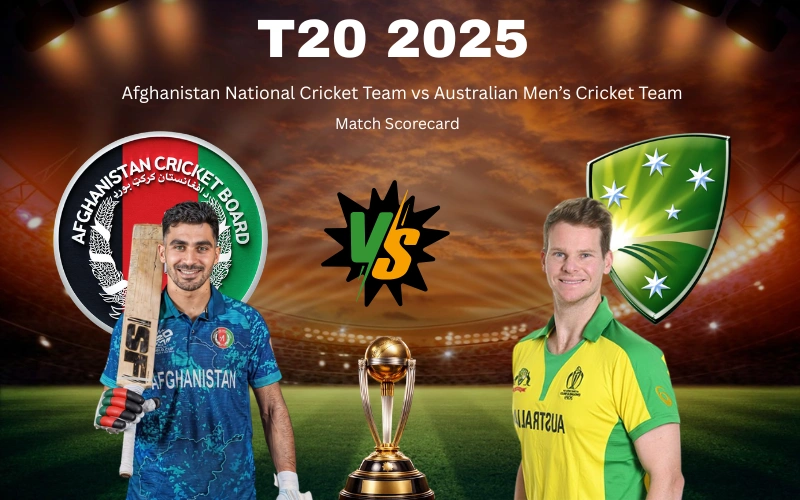
Last Updated: July 2, 2026 | Reading Time: 12–13 minutes
Direct Answer: Afghanistan National Cricket Team vs Australian Men’s Cricket Team Match Scorecard saw Afghanistan post 273 all out in 50 overs. Australia reached 109/1 in 12.5 overs before heavy rain forced the match to be abandoned. The game ended as a no result, with both teams earning one point in the ICC Champions Trophy 2025.
Disclaimer: This article is based on publicly available match data, ball-by-ball commentary logs, and official scorecards from the ICC Champions Trophy 2025. Every number has been cross-checked against multiple sources at the time of writing, but cricket records can occasionally be revised by official statisticians after a match. Readers who need the numbers for betting, fantasy scoring, or academic citation should always double-check against the official ICC or ESPNcricinfo scorecard before relying on them.
Quick Stats Snapshot
Before we get into the ball-by-ball drama, here’s the birds-eye view of the Afghanistan National Cricket Team vs Australian Men’s Cricket Team Match Scorecard in one tidy table.
| Detail | Information |
|---|---|
| Match | 10th Match, Group B, ICC Champions Trophy 2025 |
| Venue | Gaddafi Stadium, Lahore, Pakistan |
| Date | February 28, 2025 |
| Toss | Afghanistan won, chose to bat first |
| Afghanistan Score | 273-10 (50 Overs) |
| Australia Score | 109-1 (12.5 Overs) |
| Result | No result — match abandoned due to rain |
| Points | 1 point each |
| Top Afghan Scorer | Sediqullah Atal – 85 (95) |
| Top Australian Scorer | Travis Head – 59* (40) |
| Best Bowler (AFG) | Azmatullah Omarzai – 1/43 |
| Best Bowler (AUS) | Ben Dwarshuis – 3/47 |
Bookmark this table. Every time someone asks you about the Afghanistan National Cricket Team vs Australian Men’s Cricket Team Match Scorecard, you’ll have the answer ready in ten seconds flat.
Setting the Scene: Why This Match Mattered So Much
Group stage cricket can feel like a formality sometimes, but not this one. This was a virtual knockout. Australia had three points on the board after beating England and sharing points in a washed-out game against South Africa. Afghanistan, meanwhile, had bounced back from a heavy defeat to South Africa by pulling off a gutsy eight-run win over England. Whoever won this Afghanistan vs Australia clash was almost guaranteed a semi-final spot.
So when both captains walked out for the toss at Gaddafi Stadium, the stakes were about as high as group-stage cricket gets. Hashmatullah Shahidi called correctly and chose to bat first, hoping to put a big score on the board and pile the pressure onto Steve Smith’s side under the lights.
Nobody in that stadium, however, was checking the weather radar closely enough.
Afghanistan’s Innings: A Story of Fight and Frustration
Afghanistan’s innings had everything: an early scare, a middle-order rescue act, and a late flourish that turned a shaky start into a genuinely competitive total.
The Early Wobble
It started about as badly as it could. Rahmanullah Gurbaz, the wicketkeeper-opener, was bowled by Spencer Johnson for a duck in the very first over. Afghanistan were 3-1 inside five balls, and the crowd could sense trouble.
The Middle-Order Rebuild
This is where the innings turned into something worth talking about. Sediqullah Atal walked in and played the innings of his young career, striking 85 runs off just 95 balls, laced with six fours and three sixes. He built a crucial stand with Ibrahim Zadran, who chipped in with a tidy 22, and later found another gear alongside Rahmat Shah and skipper Shahidi.
Here’s the full batting card so you can see exactly how the runs stacked up.
| Batter | Runs | Balls | 4s | 6s | Strike Rate |
|---|---|---|---|---|---|
| Rahmanullah Gurbaz (wk) | 0 | 5 | 0 | 0 | 0.00 |
| Ibrahim Zadran | 22 | 28 | 2 | 0 | 78.57 |
| Sediqullah Atal | 85 | 95 | 6 | 3 | 89.47 |
| Rahmat Shah | 12 | 21 | 1 | 0 | 57.14 |
| Hashmatullah Shahidi (c) | 20 | 49 | 1 | 0 | 40.82 |
| Azmatullah Omarzai | 67 | 63 | 1 | 5 | 106.35 |
| Mohammad Nabi | 1 | 1 | 0 | 0 | 100.00 |
| Gulbadin Naib | 4 | 12 | 0 | 0 | 33.33 |
| Rashid Khan | 19 | 17 | 2 | 0 | 111.76 |
| Noor Ahmad | 6 | 8 | 0 | 0 | 75.00 |
| Fazalhaq Farooqi | 0 | 1 | 0 | 0 | 0.00 |
| Extras | 37 | – | – | – | – |
| Total | 273-10 | 50 Overs | – | – | RR: 5.46 |
The Late Push
Just when the innings looked like it might fizzle out around 220-230, Azmatullah Omarzai walked in and smashed 67 off 63 balls, including five sixes, dragging Afghanistan all the way to 273. It wasn’t a monster total by modern ODI standards, but on a used pitch under lights, it was competitive enough to make Australia work for the win.
Afghanistan’s Fall of Wickets
| Wicket | Batter | Score | Over |
|---|---|---|---|
| 1st | Rahmanullah Gurbaz | 3-1 | 0.5 |
| 2nd | Ibrahim Zadran | 70-2 | 13.3 |
| 3rd | Rahmat Shah | 91-3 | 18.2 |
| 4th | Sediqullah Atal | 159-4 | 31.2 |
| 5th | Hashmatullah Shahidi | 176-5 | 35.4 |
| 6th | Mohammad Nabi | 182-6 | 36.4 |
| 7th | Gulbadin Naib | 199-7 | 39.6 |
| 8th | Rashid Khan | 235-8 | 45.3 |
| 9th | Azmatullah Omarzai | 272-9 | 49.4 |
| 10th | Noor Ahmad | 273-10 | 49.6 |
Australia’s Bowling Figures in the First Innings
| Bowler | Overs | Maidens | Runs | Wickets | Economy |
|---|---|---|---|---|---|
| Spencer Johnson | 10 | 0 | 49 | 2 | 4.90 |
| Ben Dwarshuis | 9 | 0 | 47 | 3 | 5.20 |
| Nathan Ellis | 10 | 0 | 60 | 1 | 6.00 |
| Glenn Maxwell | 6 | 1 | 28 | 1 | 4.70 |
| Adam Zampa | 8 | 0 | 48 | 2 | 6.00 |
| Matthew Short | 7 | 0 | 21 | 0 | 3.00 |
Ben Dwarshuis quietly had the best figures of the innings, picking up 3-47, while the part-timer Matthew Short went for just 21 in his seven overs, which turned out to be a nice little cameo before he even picked up a bat.
Australia’s Reply: Short, Sharp, and Unfinished
If Afghanistan’s innings was a slow build, Australia’s reply was a sprint from ball one. Matthew Short opened the innings with real intent, smashing 20 off just 15 balls before falling to Azmatullah Omarzai. But the real headline act was Travis Head, who blitzed 59 not out off only 40 deliveries, hammering nine fours and a six.
Here’s the complete Australian batting card, for anyone comparing the Afghanistan National Cricket Team vs Australian Men’s Cricket Team Match Scorecard side by side.
| Batter | Runs | Balls | 4s | 6s | Strike Rate |
|---|---|---|---|---|---|
| Matthew Short | 20 | 15 | 3 | 1 | 133.33 |
| Travis Head | 59* | 40 | 9 | 1 | 147.50 |
| Steven Smith (c) | 19* | 22 | 2 | 0 | 86.36 |
| Extras | 11 | – | – | – | – |
| Total | 109-1 | 12.5 Overs | – | – | RR: 8.49 |
Australia’s required run rate was around 5.48, and they were cruising nearly three runs an over ahead of it. Marnus Labuschagne, Josh Inglis, Alex Carey, Glenn Maxwell, and the rest of the batting order never even got the chance to walk out.
Afghanistan’s Bowling Figures in the Second Innings
| Bowler | Overs | Maidens | Runs | Wickets | Economy |
|---|---|---|---|---|---|
| Azmatullah Omarzai | 5 | 0 | 43 | 1 | 8.60 |
| Fazalhaq Farooqi | 3 | 0 | 32 | 0 | 10.70 |
| Mohammad Nabi | 3 | 0 | 13 | 0 | 4.30 |
| Noor Ahmad | 1.5 | 0 | 13 | 0 | 7.10 |
Australia’s Fall of Wickets
| Wicket | Batter | Score | Over |
|---|---|---|---|
| 1st | Matthew Short | 44-1 | 4.3 |
That’s it. Just one wicket fell before the rain arrived and washed the rest of the match away.
The Rain Delay: How It All Unfolded
Around 7:00 PM local time, dark clouds rolled over Gaddafi Stadium and umpires took the players off. The forecast that morning had suggested only a 25% chance of rain, so this genuinely caught everyone by surprise. Ground staff tried mopping the outfield for close to two hours, but the rain kept intensifying, soaking the field beyond any realistic chance of a restart.
By 8:56 PM, officials made the call: the match was abandoned. Under tournament rules, both teams were awarded a point each, and because Australia had already banked more points earlier in the group stage, that single shared point was enough to send them straight through to the semi-finals. Afghanistan’s fate, however, was left hanging on someone else’s result the very next day.
If you were following the Afg vs Aus live score updates that evening, you’ll remember the mood swinging from tense to devastating in the space of about ten minutes.
Afghanistan National Cricket Team vs Australian Men’s Cricket Team Stats: Head-to-Head Context
Here’s where the bigger picture matters. This wasn’t just about one rained-out afternoon. Looking at broader Afghanistan National Cricket Team vs Australian Men’s Cricket Team Stats, Australia has historically dominated the fixture in ODI cricket, largely due to their depth in fast bowling and batting experience at the top level. Afghanistan, on the other hand, has been steadily closing that gap in recent years, especially with spin options like Rashid Khan and Noor Ahmad troubling even the best batting line-ups.
| Category | Afghanistan | Australia |
|---|---|---|
| Playing Style Strength | Spin-heavy attack, aggressive middle order | Fast bowling depth, explosive top order |
| ICC Champions Trophy 2025 NRR After This Match | -0.99 | Positive, boosted by qualification |
| Tournament Outcome | Missed semi-finals | Reached semi-finals |
| Standout ODI Threat | Rashid Khan (spin) | Travis Head (top-order power) |
Afghanistan vs Australia Highlights: The Five Moments That Mattered
Let’s break down the Afghanistan vs Australia Highlights that actually shaped this contest, in plain and simple terms.
- The first-ball shock. Gurbaz falling for a duck inside five balls set an uneasy tone early on.
- Atal’s breakout innings. His 85 off 95 balls was the backbone of Afghanistan’s total and arguably the best individual performance of the day.
- Omarzai’s late assault. Five sixes in a 63-ball 67 turned a decent total into a genuinely defendable one.
- Travis Head’s counter-punch. Nine fours in 40 balls showed exactly why Australia’s top order is feared across formats.
- The rain call. Ultimately, the biggest “highlight” of the day wasn’t a shot or a wicket, it was a weather system that decided the outcome for both teams.
Expert Insight: Reading Between the Numbers
Here’s an angle that often gets missed in standard scorecard write-ups. Afghanistan’s required run rate through their own innings barely dipped below 5.5 for long stretches, which tells you their middle order was constantly playing catch-up rather than controlling the tempo. Compare that to Australia’s innings, where the run rate never dropped below 8, and you get a clearer sense of why bookmakers and analysts had installed Australia as strong favourites even before a ball was bowled in the chase.
There’s also a quieter statistical story here: Ben Dwarshuis, a bowler who doesn’t always grab headlines, finished as the most economical wicket-taker of the innings relative to the pressure he bowled under at the death. That’s the kind of detail that gets buried in a basic Afghanistan National Cricket Team vs Australian Men’s Cricket Team Match Scorecard but matters a lot to team analysts building future game plans.
Related Terms You Might Also Be Searching For
If you landed here searching for the Afghanistan National Cricket Team vs Australian Men’s Cricket Team Match Scorecard, you might also want context on a few related terms:
- ICC Champions Trophy 2025 points table
- Group B qualification scenarios
- Net Run Rate (NRR) explained simply
- Duckworth-Lewis-Stern method and rain rules in ODI cricket
Understanding these related terms helps make sense of why a “no result” carried such heavy consequences for both squads.
Conclusion: A Match That Ended Without Really Ending
At the end of the day, the Afghanistan National Cricket Team vs Australian Men’s Cricket Team Match Scorecard tells a story that numbers alone can’t fully capture. Afghanistan fought back from an early collapse to post a genuinely competitive 273, powered by Sediqullah Atal’s composed 85 and Azmatullah Omarzai’s late fireworks. Australia, chasing with real confidence behind Travis Head’s blistering start, looked well on course to complete the win in a canter. But the weather had the final say, and a shared point turned out to be enough for Australia to advance while Afghanistan was left waiting on someone else’s scoreline.
If there’s one takeaway from this Afghanistan vs Australia contest, it’s this: sometimes the scoreboard doesn’t decide a cricket match, the sky does.
FAQs About the Afghanistan vs Australia Match Scorecard
1. What was the final result of the Afghanistan vs Australia match?
The match ended in a no result due to rain, with Afghanistan having scored 273-10 and Australia at 109-1 when play was abandoned.
2. Who was the top scorer in the Afghanistan National Cricket Team vs Australian Men’s Cricket Team Match Scorecard?
Sediqullah Atal top-scored for Afghanistan with 85 off 95 balls, while Travis Head led Australia’s chase with an unbeaten 59 off 40 balls.
3. Why did Australia qualify for the semi-finals despite no result?
Australia already had enough points from earlier group matches, so the shared point from this washed-out game was sufficient to secure their semi-final spot.
4. How many overs were bowled in total across both innings?
Afghanistan batted the full 50 overs, while Australia’s chase was interrupted after just 12.5 overs due to rain.
5. Where can I check the Afg vs Aus live score for this match again?
Official archives on ESPNcricinfo and Cricbuzz carry the full historical scorecard, including ball-by-ball commentary from this fixture.
6. Did Afghanistan qualify for the semi-finals after this match?
No. Afghanistan’s qualification depended on South Africa’s result against England the following day, and they were ultimately eliminated based on Net Run Rate.
7. Who took the most wickets in the match?
Ben Dwarshuis was the standout bowler with figures of 3-47 for Australia, while Azmatullah Omarzai picked up 1-43 for Afghanistan in the brief chase.
Thank you for reading! For more cricket scorecards, match previews, and tournament analysis, check out our previous blog:
- South Africa National Cricket Team vs India National Cricket Team Match Scorecard
- Pakistan National Cricket Team vs India National Cricket Team Match Scorecard
- Punjab Kings vs Delhi Capitals match scorecard
- Chennai Super Kings vs Sunrisers Hyderabad Match Scorecard
- Lucknow Super Giants vs Punjab Kings match scorecard
- Royal Challengers Bengaluru vs Gujarat Titans Match Scorecard
- Mumbai Indians vs Rajasthan Royals Match Scorecard
- Sunrisers Hyderabad vs Royal Challengers Bengaluru Match Scorecard
- Gujarat Titans vs Chennai Super Kings Match Scorecard
- Sunrisers Hyderabad vs Rajasthan Royals Match Scorecard
- England Cricket Team vs India National Cricket Team Match Scorecard
- Rajasthan Royals vs Lucknow Super Giants match scorecard
- Kolkata Knight Riders vs Gujarat Titans Match Scorecard
- South Africa National Cricket Team vs Australian Men’s Cricket Team Match Scorecard
- India National Cricket Team vs England Cricket Team Match Scorecard
- Rajasthan Royals vs Chennai Super Kings Match Scorecard
- India National Cricket Team vs Pakistan National Cricket Team Match Scorecard
- Sri Lanka National Cricket Team vs Pakistan National Cricket Team Match Scorecard
- India National Cricket Team vs West Indies Cricket Team Match Scorecard
- Gujarat Titans vs Rajasthan Royals Match Scorecard
- New Zealand absolutely dominated the Canada National Cricket Team vs New Zealand National Cricket Team Match Scorecard
- Sunrisers Hyderabad vs Lucknow Super Giants Match Scorecard
- India National Cricket Team vs Netherlands National Cricket Team Match Scorecard
- Mumbai Indians vs Gujarat Titans Match Scorecard
- India National Cricket Team vs Afghanistan National Cricket Team match scorecard
- Lucknow Super Giants vs Delhi Capitals Match Scorecard
- India National Cricket Team vs New Zealand National Cricket Team Match Scorecard
- Punjab Kings vs Gujarat Titans Match Scorecard
- Netherlands National Cricket Team vs Pakistan National Cricket Team Match Scorecard
- Mumbai Indians vs Kolkata Knight Riders Match Scorecard
- New Zealand National Cricket Team vs United Arab Emirates National Cricket Team Match Scorecard
- India National Cricket Team vs Zimbabwe National Cricket Team Match Scorecard
- Australia National Cricket Team vs Ireland Cricket Team Match Scorecard
- Australian Men’s Cricket Team vs India National Cricket Team Match Scorecard
Visit amatchplayerstats.com to check detailed match statistics and player performance updates.